Retold in our own words from Malory, Book XIII; history of the idea from Britannica · Published 30 October 2026
Pentecost at Camelot
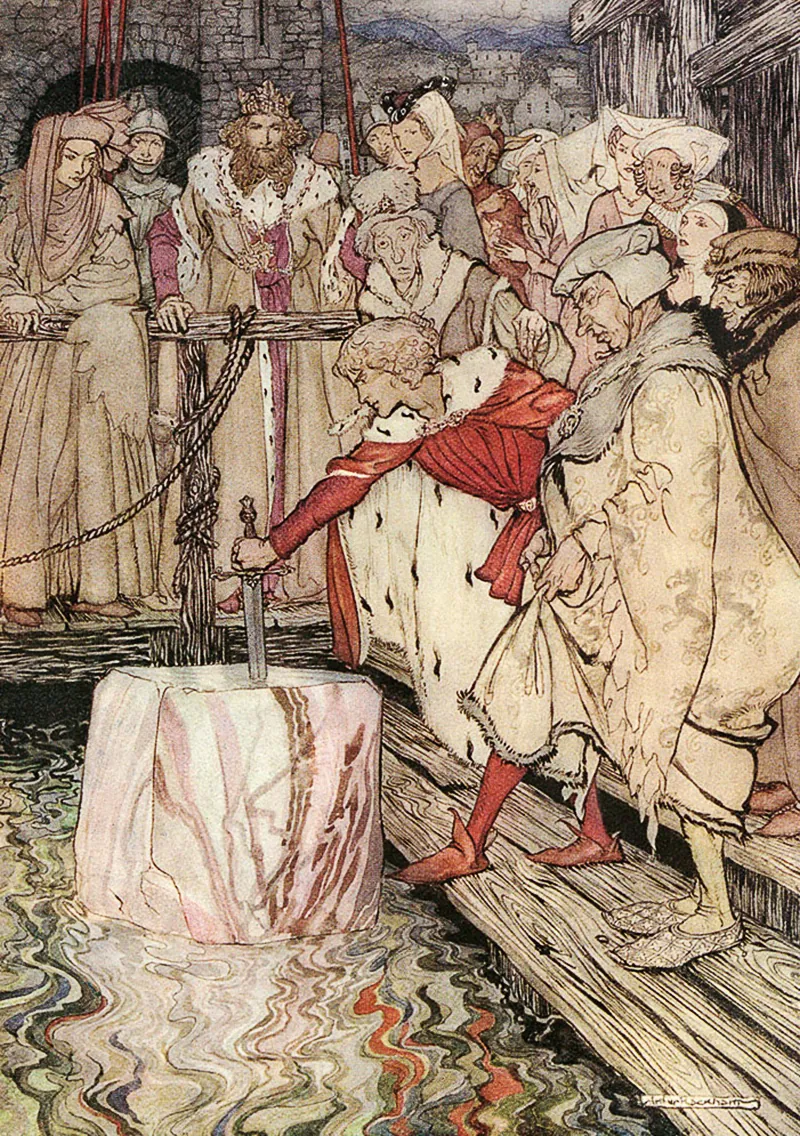
Literature At Pentecost, letters appear on the Siege Perilous, and a sword is found stuck in a stone floating on the water. Sir Thomas Malory, Le Morte d’Arthur, vol. 2 (Caxton’s text), Project Gutenberg ↗
Literature An old man brings in a young knight, Galahad, and seats him in the Siege Perilous. King Arthur shows him the floating stone, and he draws out the sword. Sir Thomas Malory, Le Morte d’Arthur, vol. 2 (Caxton’s text), Project Gutenberg ↗
Literature Later, a sunbeam brighter than day fills the hall, and the Holy Grail passes through it, covered with white samite, though nobody can see who carries it. Sir Thomas Malory, Le Morte d’Arthur, vol. 2 (Caxton’s text), Project Gutenberg ↗
Literature Sir Gawain vows to seek the Grail for a year and a day, and not to come back until he has seen it more openly. Sir Thomas Malory, Le Morte d’Arthur, vol. 2 (Caxton’s text), Project Gutenberg ↗
How the Grail story grew
Literature Chrétien de Troyes wrote his French romances around 1165–80. They include Lancelot and the unfinished Perceval, the first Grail story. Britannica: Chrétien de Troyes ↗
Literature The first surviving story to make the Grail a holy Christian object is Chrétien de Troyes’s unfinished Perceval, written late in the 1100s. Britannica (Scholars): Holy Grail ↗
Literature In the 1200s Robert de Boron linked the Grail with the cup of the Last Supper and with Joseph of Arimathea. Britannica (Scholars): Holy Grail ↗
Literature The long French prose ‘Vulgate cycle’ (c. 1225) brought in Galahad as the Grail knight. Britannica: Arthurian legend ↗
Literature The French Queste del Saint Graal (part of the Vulgate cycle, c. 1210–30) made the pure knight Galahad the Grail hero. Britannica (Scholars): Holy Grail ↗
Literature A German romance of the 1200s, Diu Krône, made Gawain the Grail hero instead. Britannica (Scholars): Holy Grail ↗
Follow the thread
Sir Thomas Malory, Le Morte d’Arthur, vol. 2 (Caxton’s text), Project Gutenberg ↗
Britannica: Chrétien de Troyes ↗
Britannica (Scholars): Holy Grail ↗
Britannica: Arthurian legend ↗
Retellings are in our own words. Every sentence above carries a label (History, Literature or Tradition) and a link to the source it was checked against. A medieval story is not a historical finding.
Source method & more reading ↗