Quoted and summarised from A. W. Moore, The Folk-lore of the Isle of Man (1891) · Published 30 October 2026
What was written down
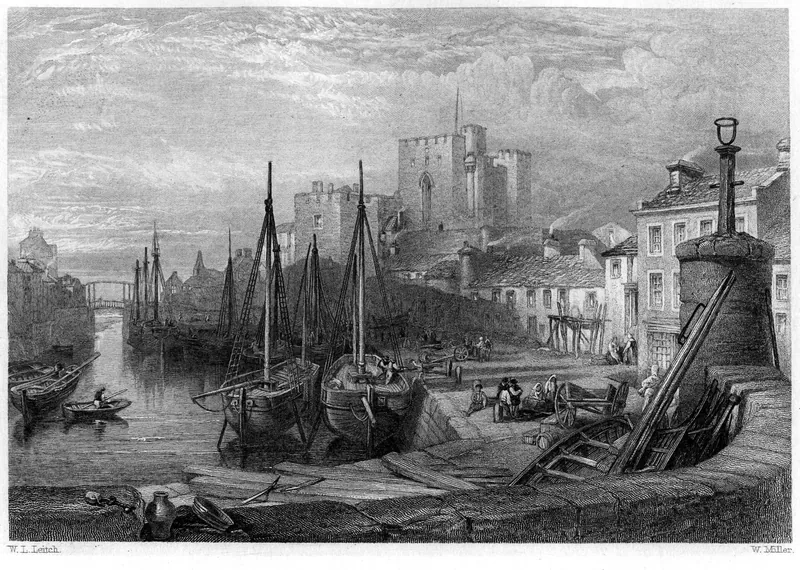
Tradition George Waldron, who was on the Isle of Man in the 1720s, recorded a belief that Castle Rushen was once held by giants until Merlin bound them with spells. A. W. Moore, The Folk-lore of the Isle of Man (1891), Project Gutenberg ↗
Tradition In Waldron’s story, a bold man went down into the vaults under the castle in about 1670. He saw a sleeping giant, at least fourteen feet long, lying on a black marble table with his head on a book and a sword beside him. A. W. Moore, The Folk-lore of the Isle of Man (1891), Project Gutenberg ↗
Tradition Another passage says the giants were not cleared out ‘till the reign of Prince Arthur, by Merlin, the famous British enchanter’. A. W. Moore, The Folk-lore of the Isle of Man (1891), Project Gutenberg ↗
Tradition A. W. Moore, who collected these passages in 1891, says Waldron was on the Isle of Man between 1720 and 1730. A. W. Moore, The Folk-lore of the Isle of Man (1891), Project Gutenberg ↗
A Welsh connection
Tradition Moore also notes a Welsh story in which King Arthur was once imprisoned for three months in a prison of bones belonging to Manawydan, the Welsh counterpart of Manannan. A. W. Moore, The Folk-lore of the Isle of Man (1891), Project Gutenberg ↗
How to read it
Everything on this page is island tradition recorded by later writers. It tells us what people on the Isle of Man said about Castle Rushen. It is not evidence that Merlin, Arthur or giants were ever there.
Follow the thread
A. W. Moore, The Folk-lore of the Isle of Man (1891), Project Gutenberg ↗
Retellings are in our own words. Every sentence above carries a label (History, Literature or Tradition) and a link to the source it was checked against. A medieval story is not a historical finding.
Source method & more reading ↗