Retold in our own words from Tennyson’s poem and Malory’s Book XVIII · Published 30 October 2026
Tennyson’s poem
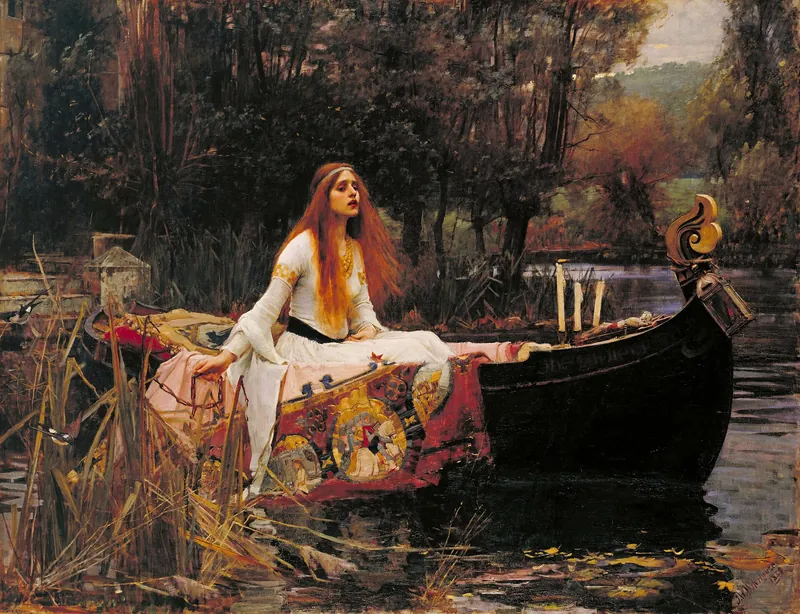
Literature In Tennyson’s The Lady of Shalott, the Lady weaves under a curse and sees the world only as ‘shadows’ in a mirror. When she looks out at Sir Lancelot, ‘The mirror crack’d from side to side’. The Early Poems of Alfred, Lord Tennyson (ed. J. Churton Collins), Project Gutenberg ↗
Literature An earlier version of the poem was printed in 1833; the text usually read today is Tennyson’s revision. The Early Poems of Alfred, Lord Tennyson (ed. J. Churton Collins), Project Gutenberg ↗
Malory’s Maid of Astolat
Literature Malory tells of the Fair Maid of Astolat, who grieves when Sir Lancelot leaves and dies for love of him. Sir Thomas Malory, Le Morte d’Arthur, vol. 2 (Caxton’s text), Project Gutenberg ↗
Literature Before she dies she asks for a letter to be placed in her right hand, and for her body to be laid in a small barge covered in black samite and steered down the Thames. Sir Thomas Malory, Le Morte d’Arthur, vol. 2 (Caxton’s text), Project Gutenberg ↗
Literature The barge is steered to Westminster, where her body comes before King Arthur and his court. Sir Thomas Malory, Le Morte d’Arthur, vol. 2 (Caxton’s text), Project Gutenberg ↗
Reading the two together
Read the poem and Malory’s chapter side by side. What does each writer tell you about the young woman, and what is left unsaid?
Follow the thread
The Early Poems of Alfred, Lord Tennyson (ed. J. Churton Collins), Project Gutenberg ↗
Sir Thomas Malory, Le Morte d’Arthur, vol. 2 (Caxton’s text), Project Gutenberg ↗
Retellings are in our own words. Every sentence above carries a label (History, Literature or Tradition) and a link to the source it was checked against. A medieval story is not a historical finding.
Source method & more reading ↗