Retold in our own words from Malory, Book XXI; history from Museum Wales, Britannica and Glastonbury Abbey · Published 30 October 2026
The battle
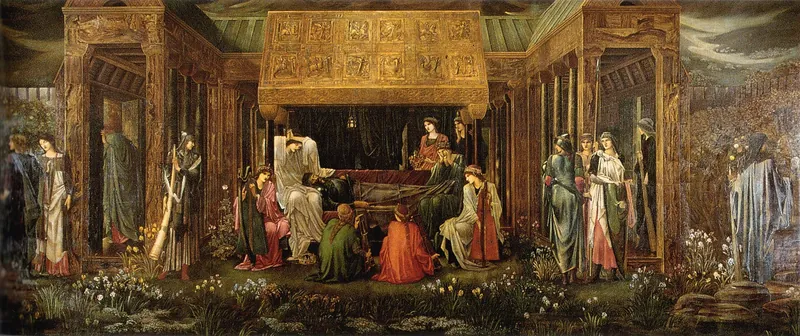
Literature Sir Mordred makes himself King of England and plans to marry the queen. Arthur comes back and lands at Dover, where Mordred tries to stop him, and Sir Gawain dies. Sir Thomas Malory, Le Morte d’Arthur, vol. 2 (Caxton’s text), Project Gutenberg ↗
Literature Gawain’s ghost warns Arthur not to fight that day. Sir Thomas Malory, Le Morte d’Arthur, vol. 2 (Caxton’s text), Project Gutenberg ↗
Literature Arthur and Mordred meet to make a treaty. Then an adder comes out of a heath bush and stings a knight on the foot. He draws his sword to kill it, both armies see the drawn sword, and the battle begins. Mordred is killed and Arthur is wounded to the death. Sir Thomas Malory, Le Morte d’Arthur, vol. 2 (Caxton’s text), Project Gutenberg ↗
The barge
Literature At the end, Sir Bedivere throws the sword into the water; ‘an arm and an hand’ catches it, shakes it three times and draws it under. Sir Thomas Malory, Le Morte d’Arthur, vol. 2 (Caxton’s text), Project Gutenberg ↗
Literature A little barge comes for him, full of ladies in black hoods, among them three queens, and they row him away. Sir Thomas Malory, Le Morte d’Arthur, vol. 2 (Caxton’s text), Project Gutenberg ↗
Literature Arthur is taken away by boat to be healed ‘into the vale of Avilion’. Sir Thomas Malory, Le Morte d’Arthur, vol. 2 (Caxton’s text), Project Gutenberg ↗
A grave, or not
Literature The next morning Bedivere finds a hermit praying beside a newly made tomb. The hermit says a group of ladies brought a body there at midnight and asked him to bury it, though he does not know for certain whose it was. Sir Thomas Malory, Le Morte d’Arthur, vol. 2 (Caxton’s text), Project Gutenberg ↗
Literature Malory then adds that ‘some men say in many parts of England that King Arthur is not dead’ and will come again, though he himself will not say it shall be so. Sir Thomas Malory, Le Morte d’Arthur, vol. 2 (Caxton’s text), Project Gutenberg ↗
Literature Malory reports the words some say are written on Arthur’s tomb: ‘Hic jacet Arthurus, Rex quondam, Rexque futurus’ (Here lies Arthur, king once and king to be). Sir Thomas Malory, Le Morte d’Arthur, vol. 2 (Caxton’s text), Project Gutenberg ↗
Literature Wace gives the first literary record of the Round Table and the first clear mention of the ‘hope of Britain’ that Arthur will return. Wace and Layamon, Arthurian Chronicles (Everyman), Project Gutenberg ↗
Avalon in older books
Literature In Geoffrey, Arthur is mortally wounded and carried to the isle of Avallon in the year 542. Geoffrey of Monmouth, History of the Kings of Britain, in Six Old English Chronicles (ed. J. A. Giles), Project Gutenberg ↗
Literature Avalon first appears in Geoffrey of Monmouth (c. 1136). His later Vita Merlini (c. 1150) calls it ‘the island of apples’, ruled by Morgan le Fay and her eight sisters, all healers. Britannica: Avalon ↗
Literature The name Avalon is close to the Welsh word for apple, afal. Britannica: Avalon ↗
What the Welsh annals say
History The Annales Cambriae (Welsh annals) record the battle of Badon and the battle of Camlann, ‘in which Arthur and Medraut fell’. Britannica (Students): Arthur ↗
History Britannica gives the Annales dates as 516 for Badon and 537 for Camlann. Britannica (Students): Arthur ↗
History Museum Wales gives 518 for Badon and 537–9 for Camlann, and says the annals were probably compiled in the mid-900s. Museum Wales: Who was King Arthur? ↗
The grave at Glastonbury
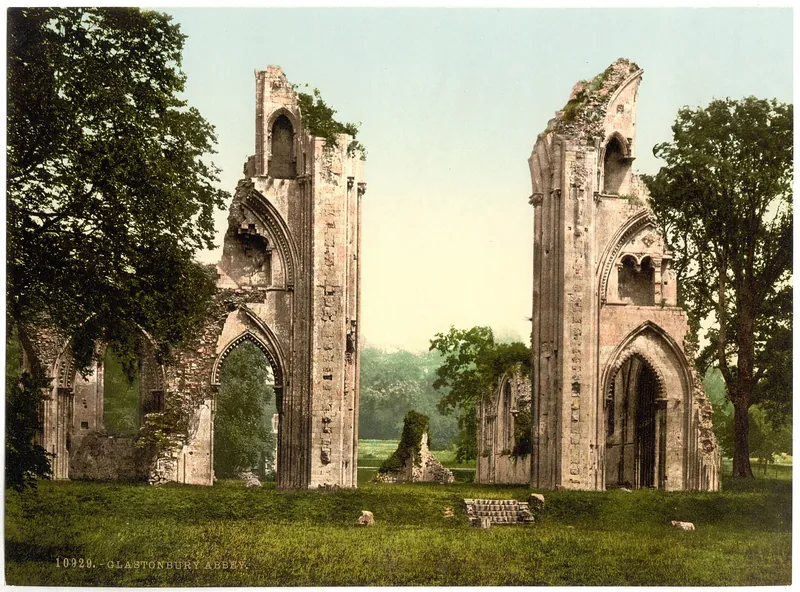
History In 1191 the monks of Glastonbury announced that they had found the grave of Arthur and Guinevere. Glastonbury Abbey: Arthur’s Tomb ↗
History Gerald of Wales wrote the earliest account of the dig, in 1193. University of Reading, Glastonbury Abbey Archaeology: Myths ↗
History The monks said they found a lead cross naming Arthur and the Isle of Avalon, which seemed to show that Glastonbury was Avalon. University of Reading, Glastonbury Abbey Archaeology: Myths ↗
History The claim strengthened Glastonbury’s standing as a place of very ancient Christian history. Glastonbury Abbey: Arthur’s Tomb ↗
History Britannica says linking Avalon with Glastonbury is just as likely to have been an attempt by the monks to use the legend for their own community’s benefit. Britannica: Avalon ↗
History Edward III visited the tomb in December 1331. Glastonbury Abbey: Arthur’s Tomb ↗
History Today there are no physical remains of the tomb. Glastonbury Abbey: Arthur’s Tomb ↗
The sleeping king and other Welsh traditions
Tradition One tradition says Arthur and his knights lie sleeping in a cave below Craig y Ddinas, near Pontneddfechan in south Wales. Museum Wales: Who was King Arthur? ↗
Tradition The capstone of Maen Ceti, a prehistoric burial chamber on Gower, is known as Arthur’s Stone, and some say the king’s ghost comes out from under it. Museum Wales: Who was King Arthur? ↗
Tradition About half a dozen Welsh Stone Age megaliths are called ‘Arthur’s Stone’. Museum Wales: Who was King Arthur? ↗
History An early Welsh poem about graves calls Arthur’s grave a wonder, because nobody knows where it is. Museum Wales: Who was King Arthur? ↗
Follow the thread
Sir Thomas Malory, Le Morte d’Arthur, vol. 2 (Caxton’s text), Project Gutenberg ↗
Wace and Layamon, Arthurian Chronicles (Everyman), Project Gutenberg ↗
Britannica (Students): Arthur ↗
Museum Wales: Who was King Arthur? ↗
Glastonbury Abbey: Arthur’s Tomb ↗
University of Reading, Glastonbury Abbey Archaeology: Myths ↗
Retellings are in our own words. Every sentence above carries a label (History, Literature or Tradition) and a link to the source it was checked against. A medieval story is not a historical finding.
Source method & more reading ↗