Literature retold in our own words; history checked against heritage and archaeology sources · Published 30 October 2026
In the stories
Literature The Norman poet Wace retold Geoffrey in French in 1155 as the Roman de Brut, adding the Round Table. Britannica: Wace ↗
Literature Wace gives the first literary record of the Round Table and the first clear mention of the ‘hope of Britain’ that Arthur will return. Wace and Layamon, Arthurian Chronicles (Everyman), Project Gutenberg ↗
History The Welsh tale Culhwch and Olwen (12th century) shows Arthur at the head of a band of heroes, which probably led to the idea of Arthur’s court. Britannica (Students): Arthur ↗
Literature King Leodegrance gives Arthur ‘the Table Round’, which Uther Pendragon had given him, with a hundred knights. Sir Thomas Malory, Le Morte d’Arthur, vol. 1 (Caxton’s text), Project Gutenberg ↗
Literature Leodegrance says the Table Round, when complete, seats ‘an hundred knights and fifty’. Sir Thomas Malory, Le Morte d’Arthur, vol. 1 (Caxton’s text), Project Gutenberg ↗
Literature One seat, the Siege Perilous, is kept for a single knight: anyone else who dares sit in it ‘shall be destroyed’. Sir Thomas Malory, Le Morte d’Arthur, vol. 1 (Caxton’s text), Project Gutenberg ↗
The table on the wall at Winchester
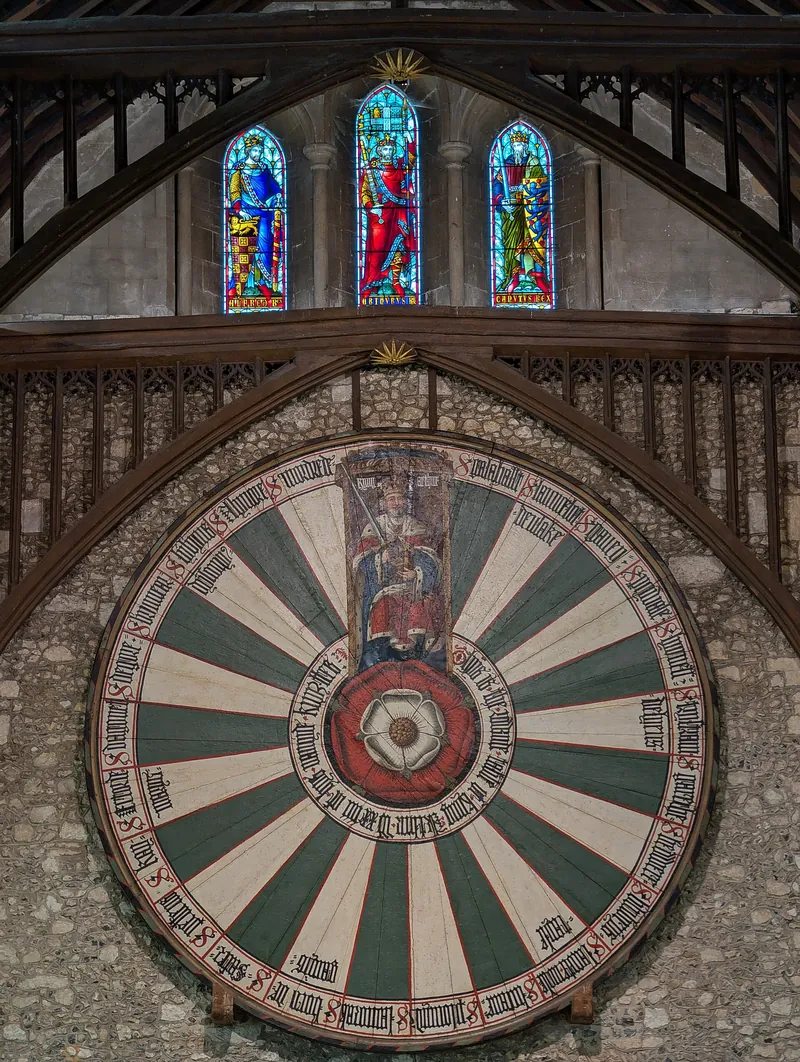
History Tests show the Winchester Round Table was built in the reign of Edward I, probably for a feast after a tournament celebrating plans for his children’s marriages. Winchester Excavations: King Arthur’s Round Table, an archaeological investigation (Biddle, 2000) ↗
History In 1976 the table was taken down and examined by a team led by Martin Biddle. Winchester Excavations: King Arthur’s Round Table, an archaeological investigation (Biddle, 2000) ↗
History Henry VIII had it painted, using the figure of Arthur to support his own claims to power. Winchester Excavations: King Arthur’s Round Table, an archaeological investigation (Biddle, 2000) ↗
History Historic Winchester says the painted King Arthur was modelled on a young Henry VIII, with the Tudor rose in the centre, and that Henry showed the table to the Emperor Charles V in 1522. Historic Winchester: Winchester’s history ↗
Literature Malory writes of ‘the city of Camelot, that is in English Winchester’. Sir Thomas Malory, Le Morte d’Arthur, vol. 1 (Caxton’s text), Project Gutenberg ↗
Literature Caxton’s preface says the Round Table could be seen at Winchester. Sir Thomas Malory, Le Morte d’Arthur, vol. 1 (Caxton’s text), Project Gutenberg ↗
Caerleon’s ‘Round Table’
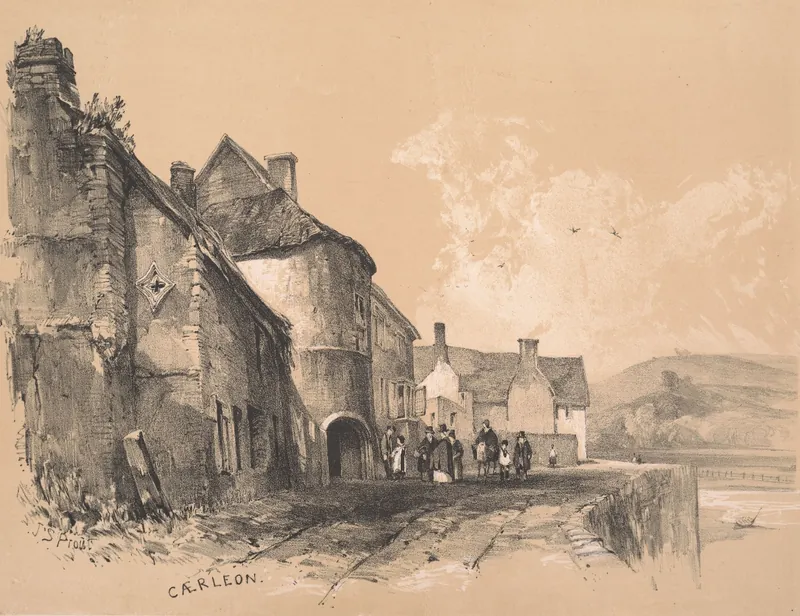
History Geoffrey of Monmouth made Caerleon, in south Wales, the court of King Arthur in his History of 1136. People’s Collection Wales (Museum Wales): King Arthur’s Round Table ↗
Literature He sets Arthur’s great crown-wearing feast at Pentecost in the City of Legions (Caerleon). Geoffrey of Monmouth, History of the Kings of Britain, in Six Old English Chronicles (ed. J. A. Giles), Project Gutenberg ↗
History The ‘Round Table’ that French soldiers were shown at Caerleon in 1405 was really the Roman amphitheatre of the fortress of Isca. People’s Collection Wales (Museum Wales): King Arthur’s Round Table ↗
History Cadw says the amphitheatre was built around AD 90 and could seat up to 6,000 people. Cadw: Caerleon Roman Amphitheatre ↗
History The Round Table first appears in Wace’s French version of Geoffrey’s History, in about 1155. People’s Collection Wales (Museum Wales): King Arthur’s Round Table ↗
History Cadw’s page says Geoffrey wrote that the amphitheatre was Arthur’s Round Table; People’s Collection Wales says Geoffrey did not mention a Round Table at all (see ‘When sources disagree’). Cadw: Caerleon Roman Amphitheatre ↗
Follow the thread
Wace and Layamon, Arthurian Chronicles (Everyman), Project Gutenberg ↗
Britannica (Students): Arthur ↗
Sir Thomas Malory, Le Morte d’Arthur, vol. 1 (Caxton’s text), Project Gutenberg ↗
Winchester Excavations: King Arthur’s Round Table, an archaeological investigation (Biddle, 2000) ↗
Historic Winchester: Winchester’s history ↗
People’s Collection Wales (Museum Wales): King Arthur’s Round Table ↗
Cadw: Caerleon Roman Amphitheatre ↗
Retellings are in our own words. Every sentence above carries a label (History, Literature or Tradition) and a link to the source it was checked against. A medieval story is not a historical finding.
Source method & more reading ↗