Retold in our own words from Malory, Le Morte d’Arthur, Books I and XXI (Caxton’s text, 1485) · Published 30 October 2026
A broken fight and a broad lake
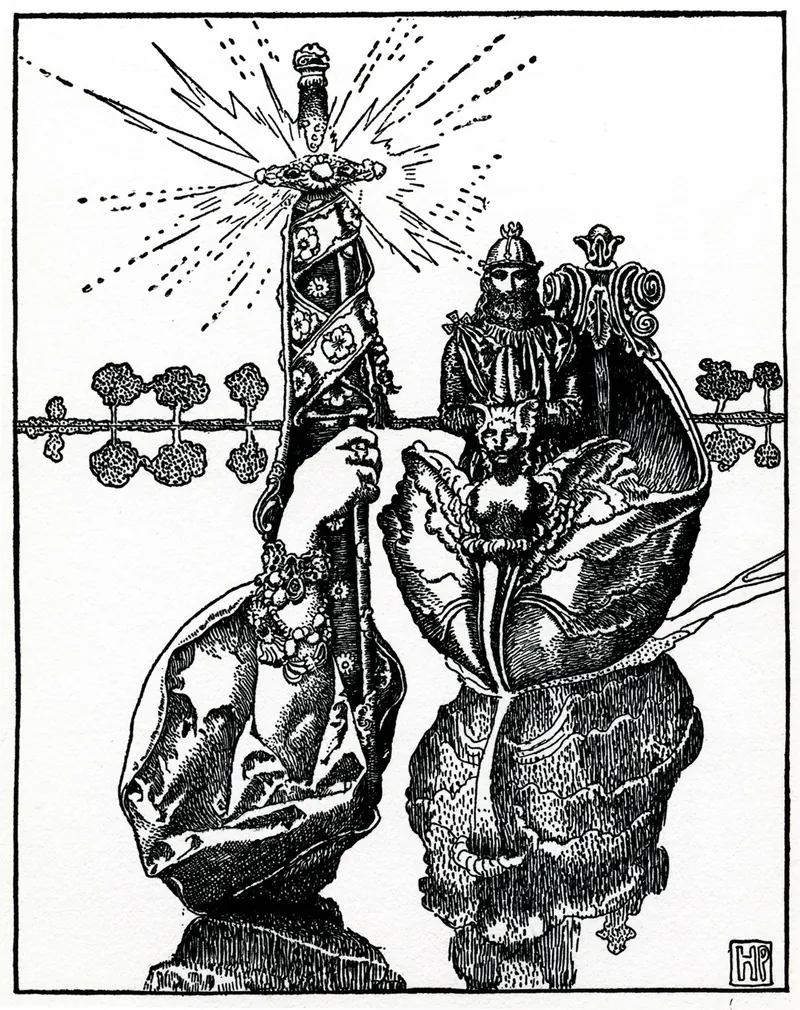
Literature After a hard fight with King Pellinore, Merlin takes the wounded Arthur to a hermit who is a skilled healer. Three days later Arthur can ride again. Sir Thomas Malory, Le Morte d’Arthur, vol. 1 (Caxton’s text), Project Gutenberg ↗
Literature As they ride, Arthur says, ‘I have no sword.’ Merlin answers that there is a sword nearby that shall be his, and leads him to a broad, fair lake. Sir Thomas Malory, Le Morte d’Arthur, vol. 1 (Caxton’s text), Project Gutenberg ↗
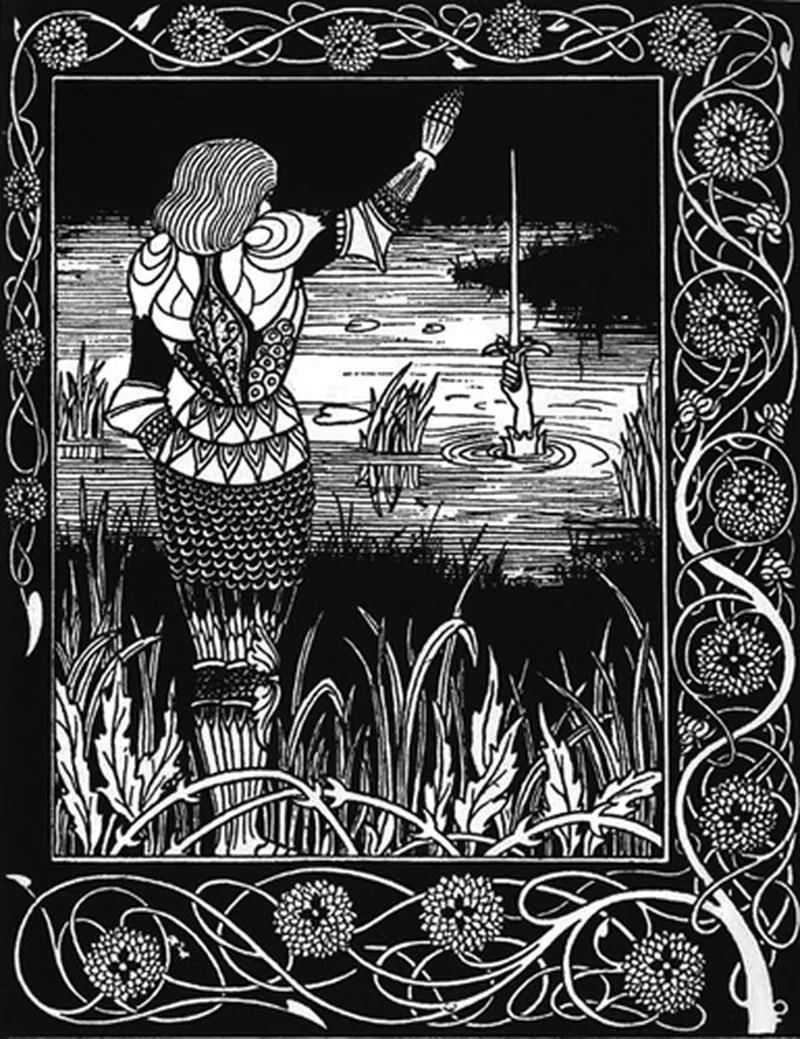
Literature In Malory, Arthur first sees the sword held up by ‘an arm clothed in white samite’ in the middle of a lake, and Merlin tells him the damsel walking on the water is the Lady of the Lake. Sir Thomas Malory, Le Morte d’Arthur, vol. 1 (Caxton’s text), Project Gutenberg ↗
Literature The Lady of the Lake says the sword is hers. Arthur may have it if he promises her a gift whenever she asks for one. Sir Thomas Malory, Le Morte d’Arthur, vol. 1 (Caxton’s text), Project Gutenberg ↗
Literature Arthur rows out in a barge, takes the sword and its scabbard, and the arm and hand sink back under the water. Sir Thomas Malory, Le Morte d’Arthur, vol. 1 (Caxton’s text), Project Gutenberg ↗
The sword and its scabbard
Literature Malory explains the sword’s name: ‘Excalibur, that is as much to say as Cut-steel’. Sir Thomas Malory, Le Morte d’Arthur, vol. 1 (Caxton’s text), Project Gutenberg ↗
Literature Merlin asks which he likes better, the sword or the scabbard. Arthur says the sword, and Merlin tells him that is unwise. Sir Thomas Malory, Le Morte d’Arthur, vol. 1 (Caxton’s text), Project Gutenberg ↗
Literature Merlin tells Arthur the scabbard ‘is worth ten of the swords’, because while he wears it he will lose no blood. Sir Thomas Malory, Le Morte d’Arthur, vol. 1 (Caxton’s text), Project Gutenberg ↗
An older name
Literature Geoffrey calls Arthur’s sword Caliburn, ‘an excellent sword made in the isle of Avallon’. Geoffrey of Monmouth, History of the Kings of Britain, in Six Old English Chronicles (ed. J. A. Giles), Project Gutenberg ↗
How the sword goes back
Literature At the very end of Malory’s book, Sir Bedivere twice hides the sword instead of throwing it into the water. Arthur knows he is lying when he says he saw ‘nothing but the waters wap and waves wan’. Sir Thomas Malory, Le Morte d’Arthur, vol. 2 (Caxton’s text), Project Gutenberg ↗
Literature At the end, Sir Bedivere throws the sword into the water; ‘an arm and an hand’ catches it, shakes it three times and draws it under. Sir Thomas Malory, Le Morte d’Arthur, vol. 2 (Caxton’s text), Project Gutenberg ↗
Follow the thread
Sir Thomas Malory, Le Morte d’Arthur, vol. 1 (Caxton’s text), Project Gutenberg ↗
Sir Thomas Malory, Le Morte d’Arthur, vol. 2 (Caxton’s text), Project Gutenberg ↗
Retellings are in our own words. Every sentence above carries a label (History, Literature or Tradition) and a link to the source it was checked against. A medieval story is not a historical finding.
Source method & more reading ↗